
When planning a legal secondary suite in Calgary, most homeowners focus on floor plans, egress windows, and fire separation. However, one of the most significant—and often overlooked—bottlenecks is sitting right inside your electrical panel. In the industry, we call it “The 60-Amp Trap.” While an older home might have functioned perfectly fine on a 60-amp or 100-amp service for decades, the addition of a legal suite fundamentally changes the electrical math of the building.
The Math of Legality: Understanding CEC Rule 8-200
In Canada, electrical safety and capacity are governed by the Canadian Electrical Code (CEC). When we apply for a building permit for a secondary suite, the City of Calgary requires a “Load Calculation” to prove the home can safely handle the new demand.
The primary rule we follow is the “100/65 Rule” for multiple dwellings. The calculation isn’t a simple addition of every lightbulb; it is a weighted formula designed to account for peak usage:
- 100% of the Unit with the Heaviest Load: We take the full calculated load of the primary residence (including the range, dryer, and base loads).
- 65% of the Second Unit: We add 65% of the calculated load for the new suite.
When you consider that a standard electric range pulls 12kW and a clothes dryer pulls 5kW, the numbers climb rapidly. While a 100-amp service can occasionally accommodate a basement suite with separate laundry if the home has no other major draws, a 60-amp service is mathematically impossible for a legal suite.
The Quick Load Audit: Why 100 Amps Often Fails
To illustrate how quickly a 100-amp limit is breached, consider a typical 1,200 sq. ft. Calgary bungalow with a 1,000 sq. ft. basement suite:
| Load Component | Estimated Demand (Watts/Amps) |
|---|---|
| Main Floor Base Load | 5,000W |
| Main Floor Range (12kW) | 6,000W (Calculated at 50% for demand) |
| Main Floor Dryer | 5,000W |
| Suite Base Load | 3,500W |
| Suite Range (12kW) | 3,900W (65% of demand) |
| Suite Dryer | 3,250W (65% of demand) |
| Subtotal | ~26,650 Watts (~111 Amps @ 240V) |
In this scenario, the home is already over the 100-amp limit before you even consider “the big hitters” like Air Conditioning, a Hot Tub, or an EV Charger. Adding a single Level 2 EV charger typically adds 32–40 amps of continuous draw, making a 200-amp service upgrade mandatory for a modern, functional home.
The EMS Alternative: Energy Management Systems
If a full service upgrade is cost-prohibitive, there is a technical middle ground. An Energy Management System (EMS), or load shared, can be used to “defer” loading. For example, the system can be programmed to pause the EV charger if the dryer and oven are running simultaneously, keeping the total draw under the 100-amp threshold. While this avoids a service upgrade, it does limit the simultaneous utility of the home.
- Grading and Landscaping: The soil surrounding the new entrance must be graded to a positive slope, directing surface water away from the stairwell.
- Drainage Systems: A dedicated floor drain at the base of the stairs is essential. This drain must be protected by a “sump” or “rock pit” if not tied to the main drainage, and it must be kept clear of debris and ice to prevent backup during a spring thaw or a heavy Calgary rainstorm.
The Physical Anatomy of an Upgrade
A 200-amp upgrade is significantly more involved than just “swapping the box” on the wall. It is a top-to-bottom overhaul of the home’s connection to the ENMAX grid.
- The Service Entrance & Mast: We must often replace the exterior “mast” (the pipe on the side of your house) and the heavy-gauge wiring—typically 2/0 Copper—to handle the increased current from the utility line. If your service is underground, this may involve trenching to the nearest transformer.
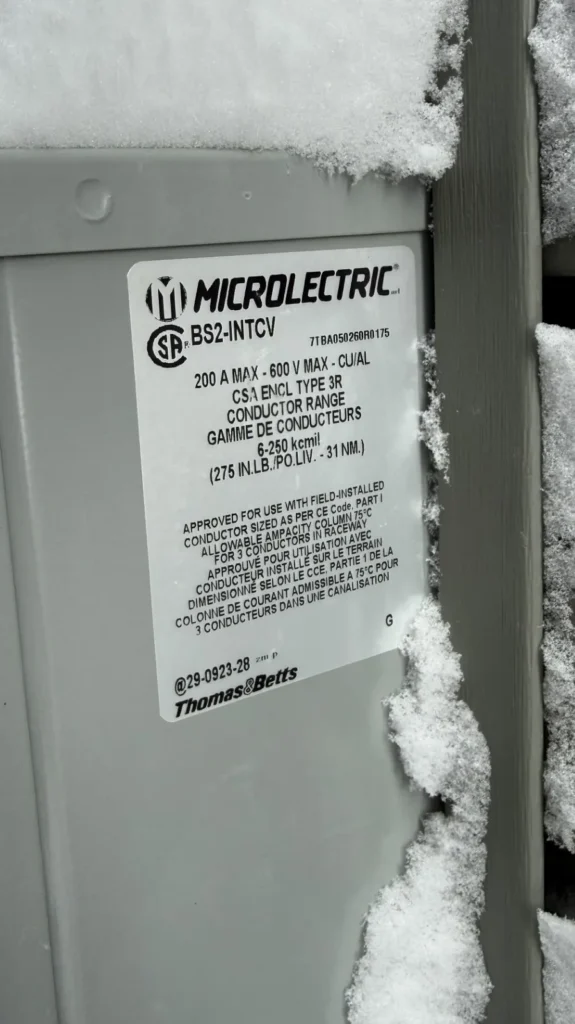
- The Meter Base: ENMAX requires a modern, rated meter socket that can handle 200 amps. We’ve found many “newer” Calgary homes actually have a 200-amp rated wire and meter already installed by the utility, but the builder only ran 100-amp wire to the panel to save money. In these cases, we can check the sticker on the side of the meter; if the utility side is already sized for 200A, the upgrade is much more economical, requiring only a new feed into the basement.
- Industrial-Grade Panels: We prioritize Square D or Siemens industrial-grade panels over budget builder-grade alternatives. The difference lies in the Bus Bar quality—high-grade copper or tin-plated aluminum bus bars offer superior heat dissipation and long-term reliability compared to cheaper alternatives that can become brittle over time.
Navigating the Calgary "Red Tape"
This is not a “weekend DIY” project. In Calgary, a Master Electrician is legally required to pull the necessary permits for a service upgrade. The process involves:
- ENMAX Coordination: Scheduling the “Disconnect/Reconnect” where the utility physically cuts power to the home so we can work safely.
- The City Inspection: A City of Calgary inspector must sign off on the work before ENMAX will restore power. This “Gold Star” is vital for insurance compliance; an unpermitted 200-amp upgrade can void your homeowner’s insurance in the event of an electrical fire.
The EV Factor and Tenant Satisfaction
Beyond legal compliance, a 200-amp service is a massive boost to resale value, often adding $5,000–$10,000 to the home’s worth by making it “EV-Ready”. It also eliminates “nuisance tripping.” There is nothing that ruins a landlord-tenant relationship faster than the tenant’s space heater tripping the breaker for the landlord’s microwave. Independent power ensures independent, peaceful living.
An electrical upgrade is often not a luxury but a necessity when considering a secondary basement suite. Notorious Suites will get it right, right from the start. Don’t let a $3,500 panel upgrade stand in the way of a $50,000 annual rental income. Let Notorious Suites handle the load.